
A History of Brinton Park
Brinton Park has long had associations with royal celebrations. In the year of Queen Victoria’s Golden Jubilee John Brinton presented this 23-acre park for the benefit of the ‘townspeople’ of Kidderminster. Brinton Park was opened on the 1st August 1887. Newspaper reports from the time tell of a scorching August day, where speeches were kept relatively short because of the blazing heat. Several thousand people attended.
While Brinton Park is a Victorian Park, it is unique in its development and in its value to the town. The park was never grand and ornamental in the way many other Victorian Parks were at the time. Its character and popularity developed gradually, with very little being added in its first 10 years, before seeing greater development and use over the turn of the century.
The creation of Brinton Park was instrumental in the expansion of the town at the time. Pockets of land around the park were bought by Freehold Land Societies, of which Brinton was a trustee. More houses were being built at this time, with groups of men forming these Societies, where they would collectively save enough money to buy plots. Often, everyday workers did not own property and lived in houses owned by masters. Voting at the time was dependent on owning property, so the Freehold Land Societies and Land Clubs were a way of enfranchising working people, an important interest of the Liberal Party.
It was far more liberal than many other Victorian parks, which restricted and policed activities as innocent as eating, playing games and even dress code. This was not the case with Brinton Park, which was used since the 1890s as a place of recreation for games like cricket and football, and was even the site of political gatherings. It was given for the working people to use freely, rather than forcing ‘appropriate’ use upon then.


In 1897, the park hosted celebrations for Queen Victoria’s Diamond Jubilee on the 22nd June. The 21st and 22nd were declared a public holiday and local school came to the park to sing songs like the National Anthem and a new song called ‘Flash the Beacons’. This service involved 7000 children and more than 10,000 attended the firework display. As a beacon park, there would be a bonfire and fireworks display to join many others across the country.
In 1902 there were celebrations in the park for the Coronation of King Edward VII and Queen Alexandra. Coronation Drive was opened as a permanent memorial. A procession was led from the Town Hall to the park and a bonfire and fireworks were accompanied by entertainment from the Military Tattoo and a torchlight procession.
In 1902 a few days prior to the Coronation of King Edward VII, five oak trees were planted here by John Brinton, the Mayor and Mayoress (Alderman and Mrs P Adam) and Mrs G A Weston and Mrs W H Moore. The trees were known as the Coronation Oaks.
In 1896 a bandstand as constructed in the park on this site. Music in the park during the summer months began in the early 1900’s when military bands played selections of music one evening a week.
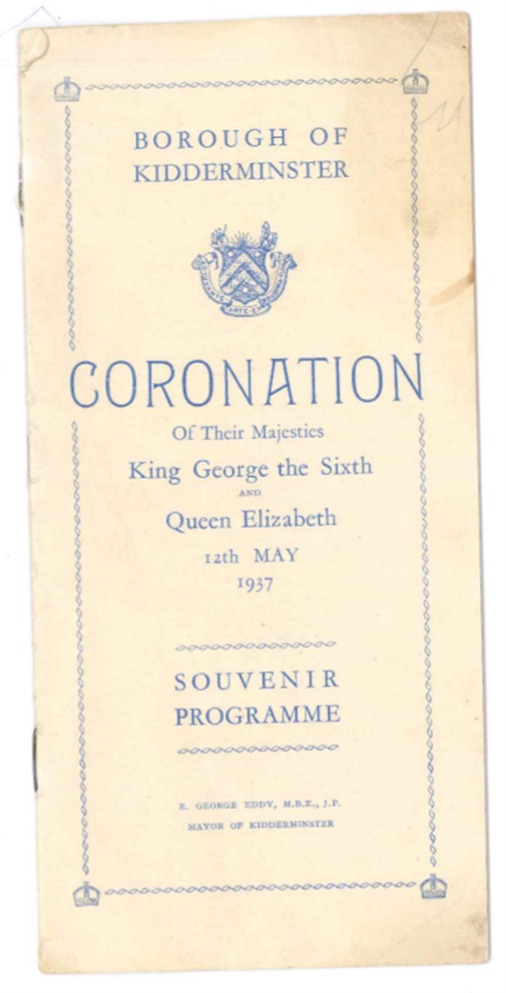
Image: Jubilee Celegration Programs
Source: Kidderminster Civic Society
In 1934, the current bandstand was opened by Mayoress Woodward, just in time for George V’s Silver Jubilee. Its design makes it very unusual – it is one of only eight like this in the country – and all the rest are at seaside resorts. The bandstand was painted with the words ‘God Save the King’ and once again, children from local school performed songs such as Land of Hope and Glory, O God our Help and Rule Britannia. The event was incredibly busy, as a commentator remarked ‘surely the park never had such a crowd in it’.
Image: Brinton Park Bandstand in 1934
Source: https://www.brintonpark.com/history/


In the 1940s and 50s, brass and military brass bands were very popular and would play in the bandstand. It was said it was hard to find any seating room on the grass for these events. In addition to a set programme, bands would take requests from the audience, before concluding with the National Anthem, whereupon all attending would rise.
Concerts continue in this park on Sundays to this day during July and August.
In Kidderminster, the first recorded meeting of Scouts was on December 16, 1908. Three boys and a Scout Master met in Church Street and called themselves the “Cuckoo Patrol”. The Shuttle reported in July, 1909 that a meeting was held in the Town Hall of gentlemen interested in the Boy Scout Movement in Kidderminster and a committee was formed. In March 1910 a “Great Display” was put on in the New Meeting Hall, the theme was “How Scouts Help Others”. In January, 1911, there were 15 troops and more than 400 boys in the district. On May 6, 1911, the Chief Scout, General Sir Robert Baden Powell, visited the town to inspect the Scouts in Brinton Park. The main streets were decorated in his honour and the Mayor and his Corporation, fully robed, walked from the Town Hall to the Park to give an official welcome, the Regimental Band of the Territorials played and 6,000 people were there to welcome him.
Another famous visitor was Emmeline Pankhurst, leader of the militant Suffragette movement. On January 24, 1912, she addressed a packed public meeting at Kidderminster Town Hall. Most of the audience at the meeting were women and just a few were allowed a concession or free admission. Most paid 2/6 to attend – which was about a day’s pay at the time for a female worker in one of Kidderminster’s carpet factories. Mrs Pankhurst, leader of the Women’s Social and Political Union (WSPU), was on a tour of the country and earlier in the day had spoken to a crowd in Stourbridge. The meeting was chaired by Reg Brinton who, in his opening remarks, asked if Mrs Pankhurst would “spare our windows” in reference to previous demonstrations, which had seen violence and vandalism. She spoke for an hour and 15 minutes.
The speech also sparked an anti-suffrage event in the town. In March, 1912 a meeting was held by the National League for Opposing Women’s Suffrage. The meeting, chaired by Rowland Hill, was poorly attended and many in the small audience voted against a motion opposing women’s suffrage. The emerging Kidderminster women’s union branch, of which Ellis Talbot was secretary, was non-militant in its campaigning, holding tea parties, for example. On September 14, 1912, The Shuttle reported a ‘Suffrage Van’ parked in Wolverley for a week to recruit members before an open-air public meeting.
Picture: Mrs Pankhurst, WSPU leader under arrest.


Her Majesty the Queen visited Kidderminster in 1957 and “Radiant Queen and smiling Duke win all hearts” was the headline in the Kidderminster Shuttle report, dated Friday, April 26, as thousands of people lined the route in “summer-like weather”. She arrived to the town three minutes late after making three unscheduled stops on the way from Stourbridge, but was warmly greeted by dignitaries at Kidderminster’s Town Hall.
The Kidderminster Shuttle’s report of the time said: “Short though their stay in Kidderminster was, the hour which Her Majesty the Queen and Prince Phillip, Duke of Edinburgh, spent in the town on Tuesday will remain an unforgettable experience for the thousands of townspeople and visitors who thronged the route from the borough boundary at Broadwaters and thence to the railway station, in summer-like weather which set the seal on a festive occasion.
Each of her Jubilees has been celebrated with events being held in the Park. This year will be no exception. In 2013, for example, a time capsule was secreted inside the Richard Eve Memorial to mark the Queen’s Diamond Jubilee.
Image Source: Kidderminster Shuttle
Brinton Park continues to thrive and Wyre Forest District Council, along with the Friends community, is committed to promoting and celebrating Kidderminster’s rich and varied history. In 2019, a bid for Heritage Lottery Fund was successfully submitted and visitors to the park will soon begin to see evidence of the extensive works that are in development. These include the construction of a new café and the restoration of the Duck Pond near the Stourport Road entrance as well as new planting.
Guided tours of Brinton Park are available on request. Please contact info@brintonpark.org.uk for more details.